This post may contain affiliate links. If you make a purchase, I may make a commission at no cost to you. For more information, please read my full disclosure.
Your sister-in-law just texted asking if you opened the baby’s Trump Account yet.
You have not opened the baby’s Trump Account. You are also, if we’re honest, not totally sure your 529 is invested in anything or if it’s just sitting there in cash like a scared little pile of money. And now there’s a third acronym to figure out — right when you’d finally made peace with the first two.
Real talk: you are not behind on this one. The 529 plan vs custodial account vs Trump Account debate is genuinely new. The Trump Account only opened for business in 2026. Nobody has had time to figure this out yet. Everyone is learning it at the same time you are.
So let’s walk through what a 529 plan, a custodial account, and a Trump Account actually do — and then figure out where you land. These aren’t three contestants fighting for one spot in your budget. They’re three different tools built for three different jobs. The question isn’t “which is best”, but “what job do I need this money to do?” If maternity leave financial planning already has your head spinning, this one is worth slowing down for — because getting it right now pays off for decades.
The 529 Plan vs Custodial Account vs Trump Account: A Quick Overview
Before we go deep, here’s the short version of how these three accounts are different from each other:
529 plan: A state-sponsored investment account built specifically for education costs. Tax-free growth and withdrawals for qualifying expenses, which now cover a lot more ground than they used to.
Custodial account (UGMA/UTMA): A standard investment account in your child’s name, with you as the manager. No restrictions on what the money is eventually used for — but no special tax advantages either, and full control transfers to your kid the moment they become a legal adult.
Trump Account: A brand-new federal program that seeds every eligible child’s account with $1,000 at birth, locks the money in a broad stock index fund until age 18, and then converts it into a traditional IRA. Available starting July 2026.
The smart money app and debit card for kids
The debit card and app that grows with your kids
Choose from 35+ customizable debit card designs
Automatic chores and allowance
The 529 Plan: Built for School, and School Just Got Bigger
A 529 plan is a state-sponsored investment account built for education costs. It’s technically named after the section of the tax code that created it — IRS Section 529 — which has to be one of the most boring names ever attached to something that can save your family real money.
Here’s how it works: you put money in, it grows, and if you pull it out for a qualifying expense, you don’t pay federal tax on the growth. Ever. No federal deduction going in (though plenty of states will give you a state tax break for contributing), and no federal tax coming out — as long as the money goes toward something the IRS recognizes as education. Understanding how compound interest works for your family is part of what makes starting one of these accounts early so powerful.
What’s Changed: The 529 Just Got a Lot More Flexible
A lot of the advice floating around is out of date. The One Big Beautiful Bill Act, passed in 2025, rewrote what counts as a qualifying expense — and it did it in a big way.
For K–12:
The old withdrawal cap was $10,000 a year, covering tuition only. Starting with the 2026 tax year, that cap doubles to $20,000 a year.
The list of qualifying expenses expanded to include curriculum and textbooks, tutoring (as long as the tutor isn’t a relative), SAT/ACT/AP exam fees, dual enrollment costs for high schoolers, and educational therapy for kids with disabilities.
For homeschooling families: Homeschool costs used to be locked out of 529 plans entirely. They’re not anymore — at least at the federal level. A few states, California among them, haven’t updated their own tax rules to match, so check yours before you assume every dollar is state-tax-free too. But the federal door is open now.
Past high school: A 529 now covers trade certifications, professional licenses, and apprenticeship programs registered with the Department of Labor — not just four-year degrees. If your kid ends up in an electrician’s apprenticeship instead of a lecture hall, the account still works for them. You can read more about what a 529 plan can be used for across all these new categories.
Contribution Limits and the Gift Tax Rule
There’s no federal cap on how much you can put in per year, but there is a gift tax rule worth knowing:
In 2026, you can give any one person up to $19,000 a year ($38,000 if you and your spouse both give) without touching your lifetime gift tax exemption or requiring extra paperwork.
You can front-load five years at once — up to $95,000 single or $190,000 married — if you want a chunk of money growing early. This involves filing a form with the IRS even when no tax is owed, so loop in a CPA first if you’re looking at that size of contribution.
States also set a total lifetime cap per account, usually somewhere in the $300,000–$500,000+ range depending on where the plan is based.
You Stay in Control — Permanently
You stay in control of a 529 permanently. Not until your kid turns 18. Permanently. You can change the beneficiary to another family member with zero tax consequence if your first choice gets a full scholarship, decides against college, or you simply have money left over.
And if there’s still a chunk sitting there after everything: as long as the account has been open at least 15 years, you can roll up to $35,000 over your child’s lifetime into a Roth IRA in their name, tax and penalty free. The amount you can roll each year is capped at that year’s Roth contribution limit ($7,500 in 2026), and your kid needs earned income to receive it — but it means an overfunded 529 doesn’t just have to sit there doing nothing.
When your family fills out the FAFSA, a 529 you own gets counted as a parent asset and folded into the aid formula at a rate of 12 percent. That’s a fairly gentle hit. And if grandma opened the 529 instead of you? Even better — grandparent-owned 529s don’t count against financial aid at all anymore.
The catch: pull money out for something that isn’t a qualifying expense, and you’ll owe income tax plus a 10 percent penalty on the earnings portion (not your original contributions — just what it grew by). A 529 rewards you for being reasonably sure this money is headed toward some kind of education, which now covers a lot more ground than it used to.
The Custodial Account: No Label, No Guardrails
A custodial account — usually called a UGMA or UTMA depending on your state (Uniform Gifts to Minors Act and Uniform Transfers to Minors Act) — is about as simple as accounts get. You, as the custodian, manage the investments. But legally, the second money goes in, it belongs to your child. Not eventually. Immediately. You’re just holding the keys until they’re old enough to drive.
That ownership setup is the whole story of this account — the good part and the expensive part both.
The Good Part: Total Flexibility
The money can go toward anything that benefits your kid. A car, a gap year, a security deposit on their first apartment — whatever they need when they’re old enough to need it. There’s no list of qualifying expenses to check against, because there doesn’t have to be one.
The Expensive Part: Annual Taxes and the Kiddie Tax
Because the account is the child’s asset, it gets taxed every year as it earns money — whether or not anyone ever touches it. That’s where the kiddie tax comes in, a rule from the 1980s meant to stop parents from parking investments in a kid’s name purely to dodge taxes.
In 2026, here’s how it works:
The first $1,350 of your child’s investment income is tax free.
The next $1,350 gets taxed at your kid’s own (usually low) rate.
Anything past $2,700 total gets taxed at your rate.
A well-funded custodial account can quietly generate a tax bill every spring, even if nobody withdrew a dime.
The FAFSA Factor — and It’s Worse Here
Because the account legally belongs to your student, FAFSA counts it as a student asset. Student assets get assessed at 20 percent — not the 12 percent parent assets get. That’s a meaningfully bigger dent in aid eligibility for the exact same dollar amount that would’ve had a gentler impact sitting in a 529 instead.
If you’re moving real money into one of these accounts — more than a birthday check here and there — a CPA or fee-only financial planner can help you run the tax and aid math before you commit.
No Going Back
Once your child hits the age of majority in your state (18 in most places, 21 or later in others), the account is entirely theirs. Not “theirs with guardrails.” Theirs. They can withdraw all of it and spend it however they want, and you have no legal say — because you never actually owned it.
You also can’t convert a custodial account directly into a 529. You’d have to sell the investments, which can trigger capital gains tax, and then contribute whatever’s left over.
A custodial account is the right tool when you want flexibility more than you want a tax break — and when you’re at peace with handing over full, unsupervised control the day your kid becomes a legal adult.
The Trump Account: Free Money With a Very Long Wait
Yes, it’s really called that. It’s a brand-new federal program — part of the same law that expanded the 529 rules — and the actual accounts opened for business in July 2026. So if you feel like you just heard about this, that’s because you did.
Who Qualifies and What You Get
Every child under 18 with a Social Security number qualifies — one account per child.
If your baby was born between January 1, 2025 and December 31, 2028, the federal government will deposit a one-time $1,000 seed, as long as you file the election for it (through IRS Form 4547, or online at trumpaccounts.gov).
Some children in certain zip codes may also qualify for an extra $250 from a charitable foundation. Worth five minutes to check if that’s you.
Contributions and Employer Perks
Family and friends can contribute up to $5,000 a year combined.
No earned income requirement — your toddler doesn’t need a paycheck for you to put money in, unlike a custodial Roth IRA.
Employers can kick in up to $2,500 a year (that counts inside the $5,000 cap, not on top of it). Some workplaces are starting to offer this as a benefit, similar to a 401(k) match.
The Lock-In Period
Here’s what really sets this account apart. During the “growth period” — essentially birth through the year before your child turns 18 — nobody can touch the money. Not you, not them. No withdrawals at all, apart from a few narrow exceptions like a rollover or fixing an accidental over-contribution.
The money also has to sit in a specific kind of investment: a low-cost fund that tracks a broad U.S. stock index (something like the S&P 500), with fees capped at 0.1 percent. No individual stocks, no bonds, nothing fancy.
What Happens at 18
On January 1 of the year your child turns 18, the account converts into a regular traditional IRA — and it becomes theirs. From that point, it works like any other traditional IRA: they can withdraw for anything, but they’ll owe ordinary income tax on it, plus a 10 percent early withdrawal penalty if they take it out before age 59½ (unless they qualify for a standard IRA exception, like a first home purchase or certain education costs).
One Tax Nuance Worth Knowing
Money you personally contribute is what’s called “basis” — you already paid tax on it, so it won’t be taxed again later. The $1,000 government seed and any employer or charity contributions don’t work that way. When your child eventually withdraws, most of that portion — plus all the growth on top of it — comes out as taxable income. It’s still free money. Just not tax-free money.
So, Do You Have to Pick Just One?
No. And here’s the part that makes this easier, not harder: these three accounts aren’t fighting each other for the same dollar. You can run all three at once for the same kid if that’s where you land.
Think of it less like picking a winner and more like matching the tool to the job:
Fairly confident there’s some kind of education in your kid’s future — whether that’s a four-year degree, a trade program, or homeschooling all the way through — and you want the biggest tax break available? A 529 plan is doing exactly what it was built to do, and it just got a lot more forgiving about what “education” even means.
Want money set aside with zero restrictions on how they eventually use it, and you’re truly at peace with them getting full, unsupervised control the moment they’re a legal adult? A custodial account is your tool.
Like the idea of a locked box that starts growing the day your baby is born, comes with actual free federal money attached, and eventually turns into a head start on retirement whether they realize it or not? The Trump Account is worth opening, even if it’s just for that $1,000.
A few practical notes: Fidelity and Charles Schwab both offer all three account types now, which makes it easier to compare fees in one place instead of juggling five open tabs. For the Trump Account specifically, you can also go straight through trumpaccounts.gov. And if you’re shopping 529 plans across states — you don’t have to use your own state’s plan — savingforcollege.com lets you compare fees and performance without wading through fine print.
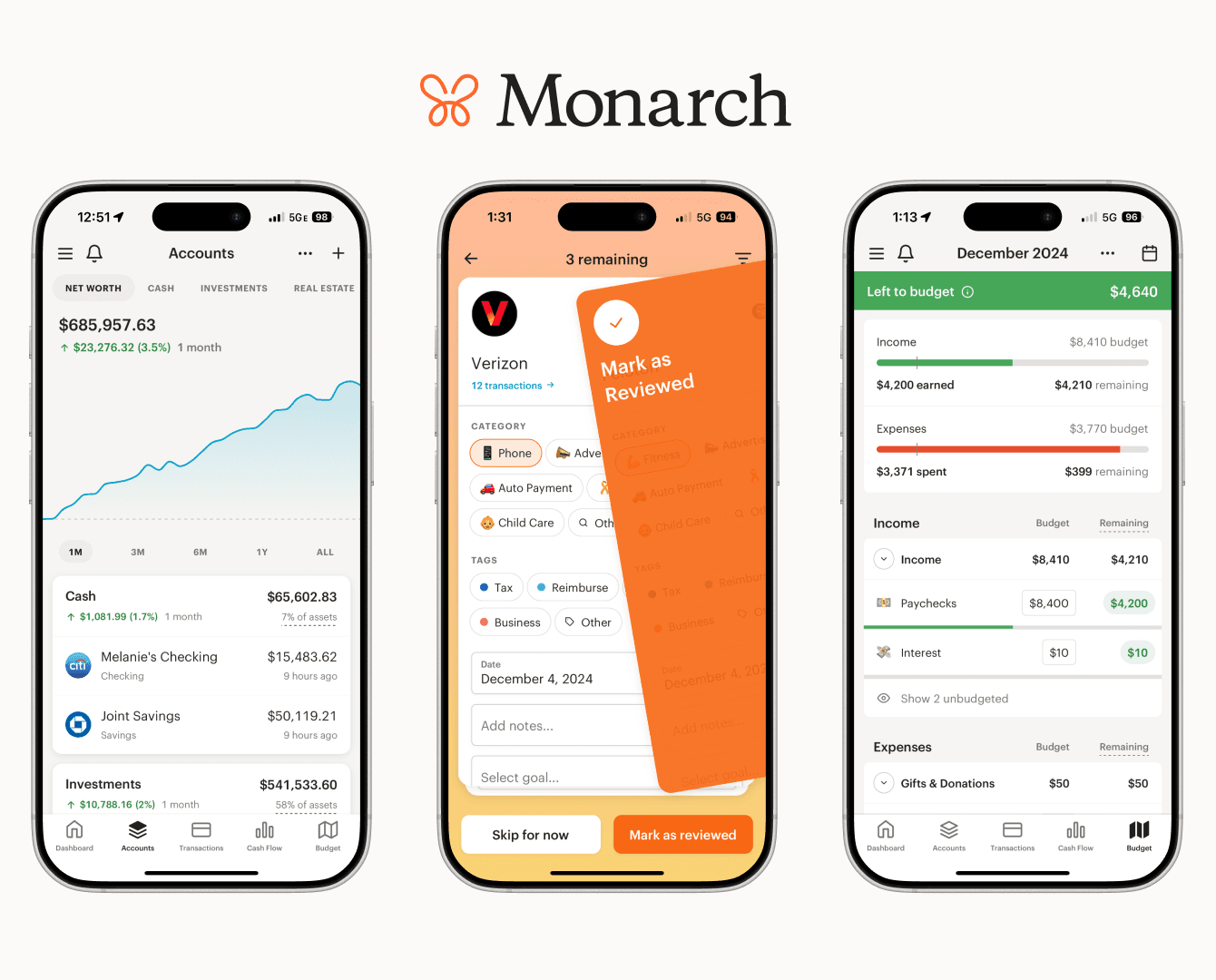
Monarch will change the way you organize your financial life. Connect your accounts and Monarch will do the heavy lifting to categorize your finances. From there, you can track, budget, collaborate, and set goals specific to you.
You don’t have to open all three today. You don’t even have to fully understand all three today — that’s what this post was for.
Pick the one that matches where you already are right now, this week, with this kid. Not the “perfect” one. The one that fits. Then open it. Ten dollars, twenty-five dollars, whatever you’ve got sitting in checking that you won’t miss. Small is not a compromise. Small is the strategy.
You can add the other two later. There’s no deadline you’re racing against, and no version of this where you did it wrong by starting with just one. And if you’re working on building an emergency fund at the same time, that’s not a conflict — it’s exactly the right order of operations.
I promise.
Frequently Asked Questions
Can I open a 529 plan, a custodial account, and a Trump Account for the same child?
Yes — there’s nothing preventing you from using all three for the same kid. Each one serves a different purpose: the 529 plan is optimized for education costs, the custodial account gives you total flexibility, and the Trump Account is a locked, government-seeded investment that converts to a retirement account at 18. Many families will use a combination depending on their goals and budget.
What happens if my child doesn’t go to college and I have a 529 plan?
A 529 plan now covers a lot more than four-year degrees — including trade certifications, apprenticeship programs, professional licenses, and homeschooling costs. If there’s truly no education path at all, you can change the beneficiary to another family member, roll up to $35,000 into a Roth IRA in your child’s name (if the account has been open 15+ years), or withdraw the money and pay income tax plus a 10 percent penalty on the growth only — not your original contributions.
How do I claim the $1,000 government seed for the Trump Account?
Eligible children (born between January 1, 2025 and December 31, 2028) qualify for the $1,000 deposit, but it doesn’t happen automatically — you need to file an election through IRS Form 4547 or at trumpaccounts.gov. Since the accounts only opened in July 2026, the exact process is still rolling out. Check trumpaccounts.gov directly for the most current instructions, as this information is likely to be updated frequently in the first months of the program.
Does a custodial account affect financial aid more than a 529 plan?
Yes, significantly. A custodial account is counted as a student asset on the FAFSA, which gets assessed at 20 percent in the financial aid formula. A 529 you own as a parent gets assessed at just 12 percent. For the same dollar amount, a custodial account will reduce your child’s financial aid eligibility more than a 529 plan would.
Is the Trump Account the same as a Roth IRA for kids?
No — it’s different in a few important ways. A custodial Roth IRA requires the child to have earned income; a Trump Account doesn’t. A Trump Account is also locked completely until age 18 and must be invested in a broad U.S. stock index fund, whereas a Roth IRA gives the account holder full investment flexibility and penalty-free access to contributions at any time. At 18, the Trump Account converts to a traditional IRA (not a Roth), meaning withdrawals in retirement will be taxable.
This post is for informational purposes only and does not constitute professional financial, legal, or tax advice.
Emily
Emily is a family finance advocate. She knows what it’s like to juggle family life, endless to-do lists, and the stress of finances. She’s passionate about making money simple, approachable, and even a little fun.